Friday, June 20, 2025

Ngā Mata o te Ariki Tāwhirimātea


Today is the public holiday associated with Matariki (Te Mātahi o te Tau/Māori New Year).

I feel very connected to our special NZ holiday and all its components. 

Matariki is an abbreviation of Ngā Mata o te Ariki Tāwhirimātea — ‘The eyes of the god Tāwhirimātea’ — my favourite Māori God as he is the God of the Wind and Weather.

All people in NZ are descended from those in their own past who used the stars for navigation, time telling, and food gathering — it is a holiday for us all to celebrate, appropriate for our place and our seasons.

I am deeply proud of Matariki as a uniquely Aotearoa celebration. It is rare (I think, unprecedented) for an indigenous tradition to be formally recognised with public holiday status — a testament to the progress and manaakitanga at the heart of our government and society at the time of its creation.

This recognition honours the cultural heritage and knowledge of Māori and invites all New Zealanders to come together to reflect, celebrate, and plan for the future in a way that respects our land, ancestors, and the stars above.

Matariki is also a star in the cluster — the mother star — and how bright she is - foretells the happenings and conditions in the coming year. The other main stars celebrated in Matariki are the seven sisters, each with their own stories and meanings. Some iwi count seven stars, others nine. Some iwi can’t see Matariki from their location in NZ due to mountains, and instead use Puanga (Rigel in Orion’s Belt - the pot cluster) as the marker.

When these stars rise together is when we celebrate Matariki — a time for:

  • Reflection — remembering those before us and the lessons of the year. The first sightings of Matariki are met with expressions of grief for those who have passed since its last appearance. A ceremony called whāngai i te hautapu may be held, involving ‘feeding the stars’ with specially prepared foods.
  • Celebration — feasting, coming together, and honouring who we are as the grieving time ends. Traditionally this marks the end of the harvest — a time for eating, singing, and dancing.
  • Planning — looking forward to the year ahead, supporting each other and the environment. A bright, clear Matariki signals a favourable, productive season; hazy, closely grouped stars mean a cold winter and delayed planting.

Here are the words I gathered from various places to put together as a karakia (prayer) for my whānau to be spoken aloud during our gathering at Matariki. It includes my translation of the meanings (that part is intended for silent reading at the end of the spoken Reo statement)

 Matariki te tipua (Matariki is sacred)

Matariki te tawhito (Matariki is ancient)

Tau mai te wairua, mai ngā ira atua, ki te ira tangata (Welcome the spirit, welcome the life force of the universe into the people)


Mānawa maiea te putanga o Matariki! (Celebrate/Hail the rise of Matariki - the appearance of Matariki cluster)

Mānawa maiea te ariki o te rangi! (Celebrate/Hail the God/Lord/Chief of the Sky)

Mānawa maiea te Mātahi o te tau! (Celebrate/Hail the New Year)


Tuku anga mate o te tau ki a Pōhutakawa whao whetūrangi hea koutou (We release the dead of the year to Pōhutukawa - star associated with people who have passed on - Our loved ones have now become the stars)


E tū Tūpu-ā-nuku (Behold Tupu ā - nuku - star associated with everything that grows in the soil to be harvested or gathered for food)

E tū Tupu-ā-rangi (Behold Tupu ā rangi - star connected with everything that grows up in the trees - fruits, berries, birds)

E tū Waitī (Behold Waitī - associated with all fresh water and the food sources that are sustained in those waters)

E tū Waitā (Behold Waitā - associated with the ocean and food sources within)

E tū Waipuna - ā - rāngi (star for the rain - "water that pools in the sky")

E tū Ururangi (star for the winds - Māori has many names for different winds, where they come from and how strong they are)

E tū Hiwa-i-te-rangi (star associated with granting our wishes and realising our aspirations for the coming year - "to grow lush in the sky")


Matariki atua ka eke ki runga (Great Matariki rising above us)

Nau mai ngā hua (Bring forth the bounty)

Nau mai ngā taonga (Bring forth the treasures)

Nau mai te Mātahi o te tau (Bring forth the New year)


Hau mi e, hui e, Taiki e (Together in union, we are one)

Tihei Mauriora! (Let there be life)

 This year, the ritual of Tuku anga mate o te tau ki a Pōhutukawa whao whetūrangi hea koutou — the ceremonial release of the spirits of those who have passed to the pōhutukawa star — carries deep significance for our whānau. The pōhutukawa, often referred to as the “tree of the dead,” represents the sacred journey of our loved ones’ spirits returning to the stars. In te ao Māori, it is believed that the spirits travel to Te Rerenga Wairua (Cape Reinga - the place of leaping), descend the roots of the ancient pōhutukawa tree, and begin their journey to the ancestral homeland of Hawaiki.

Matariki marks this passage with reverence. The ritual of whāngai i te hautapu — “feeding the stars” — involves preparing food as an offering to the stars, especially Pōhutukawa and those connected to loved ones we've lost. It is a symbolic act of remembrance, honour, and connection — one that reinforces the enduring bond between the living and those who have passed.

This year, I feel the weight and comfort of this tradition more than ever. Since last Matariki we lost a beloved member of our whānau — my brother-in-law, Perry — after his drawn-out and heart wrenching transition from this world to the next.

As we gather to mark Matariki this year, we carry his spirit with us, releasing him to the stars with aroha and grief in equal measure.

This ancient practice reminds us that death is not an end but a transition — a return to the cosmos and the ancestral world.

The ritual helps us to let go with aroha and respect, while also opening our hearts to healing and renewal.

In this way, Matariki connects us deeply — not only to the cycles of the natural world and the stars above but to each other, and to those who came before us.

We are reminded that our ancestors live in the sky, watching over us through the shimmer of Matariki.
Their stories, like stars, help us navigate what’s to come.
Even in darkness, there is guidance.
Even in farewell, there is light.

I am quite besotted with how Matariki holds space for all these phases — grief, gratitude, and growth.

It doesn’t rush us past the hard parts or demand that we have everything figured out.
Instead, Matariki gently reminds us to lift our gaze, breathe in the cold morning air, and keep going.


The stars have risen — and with them, so do we… 

References and further reading:


For Perry. 


Friday, May 5, 2023

NZSL Week: Your Invitation to Start Signing

 New Zealand Sign Language (NZSL) is the main language for around 4 000 New Zealanders and uses signs to express concepts supported by movements of the face, head and upper body to convey grammatical and expressive meaning.

A fingerspelled alphabet is used mainly for proper nouns and terms that have no equivalent sign. It is common for people who use sign language as their primary language to be given a sign as a name based (rather than finger spelling) This sign will be based on a physical characteristic they have or personal trait their close contacts know them by.
The language is closely related to Auslan (Australian Sign Language) and BSL (British). Some British/Scottish immigrants arrived in NZ with BSL as their communication tool. In the mid to late 1800s deaf NZ children were sent to schools for the deaf in Australia and Britain for their education - BSL was used there at that time.
In 1877 MP William Roulston from Canterbury pushed for deaf children to be able to be educated in NZ rather than having to be sent over seas which resulted in the first school for the deaf in NZ being built in Christchurch with children from all over the country travelling there. At this point though it was thought best to avoid sign language and teach deaf children to lip read and speak English (Gerrit van Asch was a proponent of the ‘oralist’ teaching method and believed that children who could not speak or lip read would be too feeble minded to be educated. Children ended up secretly using sign language amongst themselves anyway).
A second school was built in Auckland during WWII as there was concern about children having to cross the cook strait with the possibility of Japanese submarines!
Deaf schools have turned out to be the most important contributing factor in the development (and spread) of NZSL.
Right up until the mid 1980s sign language was used relatively privately in the deaf community as it was stigmatized in public life. Over the years the signs took on a local New Zealand flavour and became different enough to be officially called NZSL.
NZSL was recognised as a language in the 1990s and made an official language of NZ along side English and Te Reo by the New Zealand Sign Language Act 2006. As signs express concepts through visual elements rather than coming from spoken words, NZSL signs can be translated into English and te reo Māori.
Only around 5% of NZers acquire NZSL as a first language from birth (this is around the percentage of children born to deaf parents). 
In 2018, about 23,000 people in New Zealand had some knowledge of NZSL.
NZSL is dynamic - as is any language - signs for new concepts (such as new technology) and new concepts and experiences to reflect changing in society are constantly being added. 
NZSL Week is a perfect time to jump into the sign language experience in your own way Smile


I have added some links for you below to support your participation (many are supported by YouTube videos so don't forget to look there for resources too).


NZSL Week website – specifically geared up for NZSL week with resources and info


NZSL website – website includes some excellent videos (no sound required) showing how to sign a variety of common phrases (searchable dictionary and integrated with  Te Reo which I found super interesting!) If searching a phrase try just the first word e.g. How (and you will get How are you?, How many?, How old? etc


Order your hot drink in NZSL! – Ake Ake promotion but you have to get in quick!


https://www.deaf.org.nz/ website


Saturday, October 22, 2022

The Do Something Principle (With Thanks to a Pommel Horse Champion)

This was a week — let’s call it That Week — when everything I was juggling suddenly became made of knives. Too many high-tension points converging at once. Financial pressure. Personal uncertainty. Some family stuff. The news. My own nervous system.

Nothing catastrophic. Just... too much.

And in the middle of this slow-burning chaos, I was doing what many of us do: scrolling aimlessly in the hope that somewhere, amid the noise, I’d stumble across the thing that would help me feel less paralyzed. I didn’t expect it to come from an Olympic gymnast.

But it did.

Rhys McClenaghan, world champion pommel horse magician (technical title), made a video for his Patreon supporters. And it was in that video — one I nearly didn’t watch because “productivity advice” in high-anxiety mode is often just guilt in a motivational hoodie — that he introduced a ridiculously simple little diagram:

Action → Motivation → Inspiration → Action (and so on, forever).

He calls it the Do Something Principle. It's not original to him — I think Mark Manson might have used it first — but Rhys explained it in his own way, with clarity and heart. No fluff. No hype. Just this:

You don’t wait to be inspired in order to act.
You act, and that action generates a spark.
That spark leads to motivation.
Motivation generates inspiration.
Inspiration gives you the energy to keep going.
And the cycle repeats.

At the time, I was hovering somewhere between “frozen” and “freaking out.” Everything felt like too much, so I was doing nothing — which, of course, was only adding complications. Rhys's little loop made it clear: I didn’t need a grand plan or a burst of motivation. I just needed to start. Pick one small thing. Move. The rest would follow. And, to my genuine surprise, it kind of did.

Now, in case it’s not obvious, I have never touched a pommel horse. I am about as far from a gymnast as a person can reasonably be without violating the laws of physics. But Rhys’s channel drew me in long before this video. It wasn’t the gymnastics (though he’s phenomenal). It was his self-motivation. His ability to set goals, make plans, and work toward them with steady determination.

It made me wonder: have I over-relied what I consider my superpowers - adaptability and patience —are these at the expense of ambition? Of achievement?

Are those mutually exclusive? Or is that just another loop I need to break?

I still don’t have an answer on this. But I do have a screenshot of that diagram within easy reach now. And whenever things feel like too much, I return to it.

 Start with action. 

Any action.

 Even writing this post.

So thank you, Rhys — from this anxious non-gymnast in a faraway corner of the world. You did something. And it helped.


Tuesday, June 7, 2022

I don't think the world is dying


There’s a theme I’ve seen echoing around the digital void lately — “the world is dying.”
I get it. Climate anxiety is a thing. Late-stage capitalism is looking... well, pretty late. And if your feed is anything like mine, it’s a steady diet of heatwaves, plastic-filled oceans, political unravelling, and billionaires escaping into orbit like rats from a sinking ship.

But here’s my perspective:
I don’t think the world is dying.
I think the version of life that the Western world has come to know and cling to with white-knuckled intensity… that’s what’s in its death throes.

And maybe it needs to die.

Let’s be honest — humans have been a bit of a disaster in the “caretaker of the planet” department. Arrogance and self-importance have been our party tricks for generations now. It’s not that we’ve broken the world; it’s that we keep pretending we own it.

But the world?
She’s survived asteroid collisions, supervolcanoes, ice ages, and a whole host of mass extinctions without even blinking. We are, by comparison, a momentary blip — a flash of carbon-based confidence in the infinite expanse of cosmic time. And despite our best efforts to mess it all up, the planet isn’t dying. It’s adapting. It’s evolving. It’s shrugging off what no longer serves.

Including us, if it must.

Now before you reach for your compostable tissues — this isn’t a nihilistic rant. It’s a permission slip.
To breathe.
To let go.
To stop pretending that you alone are responsible for all of humanity’s mess.

We’re each just a single thread in this enormous, complicated, often absurd tapestry. What you can do (what it’s my intention every day to do) is live with integrity and joy in your own corner of it. Do the best you can, and be kind to your small ecosystem of people, places, and passing moments.

Because here’s the truth I’ve landed on:
If I’m doing the best I can, then carrying daily negativity and self-blame doesn’t serve anyone — least of all the world I do want to help.

I can’t control others’ choices. I’m not responsible for the whole system. I didn’t ask to be born into late capitalism, climate chaos, or whatever season of global collapse we’re in.

But I can choose my response.
And today, I choose peace. I choose joy. I choose to keep showing up with awareness, action, and a little grace for myself and others.

The world isn’t dying.
But the illusion of what we thought the world was?
That’s a different story.


Tuesday, April 28, 2020

For Posterity...Life in New Zealand During the COVID-19 Lockdown

28 April 2020

The Coronavirus disease 2019 (COVID-19) is an infectious disease caused by severe acute respiratory syndrome coronavirus 2 (SARS-CoV-2). It reportedly started at a seafood market in the city of Wuhan, the capital of the Hubei province in China, somewhere around Dec 2019 (although it is possible that it started in November or even earlier and that China was late to acknowledge the import of the disease). The world has not seen a pandemic such as this since the misleadingly labelled "Spanish" Flu pandemic that swept the world in 1918. That one hit on the tail end of World War 1 and in just two months killed half as many people (around 9000) as had just been killed in the war (about 17000) - both significant numbers in a country which had a population of barely 1 million people at that time. Ironically it was returning soldiers that brought the pandemic back to New Zealand with them.

The Pandemic Begins

As of today 3,041,550 million people globally have tested positive for Corvid-19. Many more people worldwide have the disease but are not able to be tested for a variety of reasons including government unpreparedness and government and society apathy.
At first, just three symptoms were indicators of the virus: shortness of breath, cough and fever. Then it was noticed that people with no or very mild symptoms could test positive and also pass the virus to others. This prompted New Zealand to 'go hard and go early" introducing a lock-down that kept us all at home and reduce our social contact as much as possible for 33 days. Later the CDC added the following official symptoms:

    Chills
    Repeated shaking with chills
    Muscle pain
    Headache
    Sore throat
    New loss of taste or smell

New Zealand’s Lockdown Response

New Zealand's own Dr Siouxsie Wiles produced the following graphic (which went 'viral' pretty quickly and has been referred to by millions around the world).


Total recorded, attributed deaths world wide today stand at 211,159 (this stat is from the Johns Hopkins stats - this is the site I have used daily to record and make percentage calculations). In the coming months this figure will, no doubt, prove inaccurate as deaths in the preceding months were misdiagnosed or somehow, in all the panic, just plain unaccounted. The majority of the deaths have reportedly been in the over 70 year old age group and those with underlying health issues. 

As of yesterday, Monday 27 April 2020, New Zealand, where I am currently living, has been in Level 4 'lock-down' for 33 days. Personally, I have been in lock-down for about 37 days. At midnight this morning we moved down to level 3. The hope is that our team of 5 million (as our Prime Minister calls us) has done enough in this lock-down to continue the short road to fully eliminate this virus from our shores and keep us safe until a mass vaccination can be developed and rolled out (the plan there being that the majority of people will take it - along with the knowledge that a number of people wont - hopefully not a significant number). Our lock-down has been combined with strict border controls and lock-down rules (we 'went hard and early') and lessons learnt from our compulsive watching of daily combined press briefings from our Prime Minister and our Director General of Health. These have involved a high level of transparency and openness. Strong and caring leadership. Our government closed the border to everyone but returning New Zealand nationals/residents and made it mandatory to self isolate for 14 days for anyone entering the country. Those without an isolation plan are put into lockdown in hotels or other government monitored accommodation. 

Life Inside the Bubble

Social distancing quickly became the phrase on everyone’s lips — a new buzzword for the strange reality of keeping our distance from others, both socially and physically. In New Zealand, that meant staying within our "bubbles": the people we lived with as of 11:59pm on Wednesday 25 March, when we were given just 48 hours' notice before the country entered Level 4 lockdown. People over 70, those with weakened immune systems, or with underlying health conditions were urged to self-isolate completely.

Only essential businesses like supermarkets, pharmacies, petrol stations and dairies were allowed to stay open. Everything else — retail stores, trades, offices — closed their doors. Tape was laid on supermarket floors to keep shoppers spaced two metres apart. One person per bubble was nominated as the household shopper, and strict item limits were introduced to curb panic buying. Still, shelves were stripped bare of toilet paper, disinfectants, paper towels, laundry powder, hand sanitiser, flour and yeast.

Medical services stayed open but moved to phone or video consultations wherever possible. Those who could work from home did so. But playgrounds, bush tracks, beaches, pools, libraries and gyms were off-limits. Entire sports seasons were scrapped. Concerts, tours, weddings, holidays — cancelled. Funerals could only be attended by people within the same bubble as the deceased. Churches, mosques and temples closed. No in-person gatherings, no social visits, no popping by for a cuppa. If we did go outside, we had to stay local, keep our distance, and obey the 2-metre rule.

Hospitals, rest homes and hospices shut their doors to visitors. Meanwhile, shortages of masks, gloves and gowns left many front-line workers without the protection they needed — a worrying echo of what we were seeing around the world.

Still, in the midst of all that stress and restriction, moments of creativity and connection emerged. One family’s Lockdown Boogie went viral (the good kind of viral!) showing how people across the country were finding ways to stay upbeat, connected, and just a little bit silly — even when dancing in their living rooms.


Global Impact

Across the globe, hospitals are buckling under the pressure. There aren’t enough ventilators. There aren’t enough ICU beds. There aren’t enough nurses, doctors, gowns or gloves. Wuhan, Italy, Spain, Iran, the UK and the USA are the worst hit so far — with the virus infecting nearly 3 million people and claiming over 206,000 lives. The youngest known fatality is just six weeks old.

China initially reports a 3% mortality rate, but many believe the true toll is higher — possibly because the virus spread quietly before anyone knew what it was. Global figures are suggesting something closer to 10%.

In New Zealand, we have 1,121 confirmed cases and 19 deaths. Around 75% have recovered. It’s sobering, but still relatively low — thanks, in part, to our early lockdown, closed borders, and the calm daily briefings from Prime Minister Jacinda Ardern and Director-General of Health Dr Ashley Bloomfield.

Around the world, industries are adapting fast. Distilleries are switching to hand sanitiser. Breweries are making PPE. Car manufacturers are building ventilators. Tip lines have been set up so people can report others who are breaking isolation rules, underpaying staff their subsidy, or price-gouging. Streets are mostly empty. A few people wear gloves and masks. Essential workers are still going to work — and many are scared. Health workers worry about bringing the virus home.


Financial & Social Adjustments

The government wage subsidy scheme is helping people hold on. Businesses are paid $580.80 for each full-time worker (over 20 hours) and $350 for part-time workers, and they’re expected to pass on at least 80% of normal pay. For some, it’s a lifeline. For others, it’s not quite enough — but it’s something.

This is the Novel Coronavirus (COVID-19) pandemic. The World Health Organization declared it on March 11th, 2020, and we’re now four weeks into living under the New Zealand alert system. This is life for now. Possibly for a while.

Moving into Level 3

At Level 3 the country moves to allowing businesses to open up as long as they can provides contactless click and collect, delivery and ordering. No customers are to enter any business’s premises. Workers have to maintain 2 metres distance at all times with other co-workers. They are to wear masks, gloves when they are to be closer than 2m to another person or are manning a click and collect station. Hand sanitiser and cleaning products are of the utmost importance with everything needing to be cleans after every use. Breaks are to be staggered with limited numbers allowed in rooms such as smoko rooms and toilets. We even can only use one stair case to walk up and one to walk down. Our stores have been repurposed into click and collect stores. Checkouts have been turned into packing stations, all sales are done on line and cashless and contactless. We are still to stay home as much as possible. Only allowing one or two people into our bubbles. 

 Still here, waiting

There’s no neat ending here. No ribbon to tie around this story. We’re still in it. Still trying to make sourdough starters. Still waiting for masks to arrive in the mail. Still watching the 1pm updates like they’re the most gripping TV drama in the world.

But we’re okay. Tired, rattled, homesick for a version of life we didn’t appreciate at the time — but okay.

So that’s where we’re at. Not over. Not through it. But here.

Still here.


Monday, September 17, 2018

This Week in World History

Did you know that New Zealand was the first self-governing country in the world to grant the vote to all adult women?

This allowed ALL women in NZ (with the exception of prison inmates) to officially and legally have their say on the decisions and laws that impacted them for the first time in November 1893.
I say ‘all’ proudly, as even subsequently, in other select places, rights were not given straight away to all women but selected pockets that were deemed worthy such as the wealthy, property owners or rate payers.
Previously only the Isle of Man, as an internally self-governing dependant territory of the British Crown, had enfranchised women property owners in 1881 and on Pitcairn Island female descendants of the Bounty Mutineers were allowed to vote for ruling council members from 1838.
It was not until after WW1 that Britain and America allowed women the vote.

Interestingly (to me, at least!) this would have occurred even sooner in NZ had it not been for the concern of certain members of parliament with friends (and fingers) in the Liquor industry who opposed the bills put forward to parliament to allow the vote on the grounds that women would use their new found influence to negatively impact the availability of liquor (as was one of the main drives of the Women’s Christian Temperance Union in those times, which they believed went hand in hand with improving the conditions for women and family life in general).

Kate Sheppard and fellow suffragists travelled our country gathering support (and educating) under fierce opposition. Women who came out in support were ‘recommended to go home, look after their children, cook their husbands’ dinners, empty the slops, and generally attend to the domestic affairs for which Nature designed them’; and told they should give up ‘meddling in masculine concerns of which they are profoundly ignorant’.
They gathered signatures of around 32, 000 women from all over the country, glued the sheets together and presented it dramatically as a 270 m roll bowled across the chamber of the House in July 1893.
The Electoral Act 1893 was passed (by both houses) and became law on Sept 19th (even with the opposition of our Premier at the time; Richard Seddon – a friend of the Liquor Industry!).
You can view the list, read the names of the people that signed and find out more info about the NZ Suffrage on the NZhistory.govt.nz website.
Nelson had its own list of signatures of support which was submitted separately and subsequently lost from history so we can’t look at that – however,  I have included below, the text of a leaflet published by the Women's Christian Temperance Union in May 1888, which was sent to every member of the House of Representatives. I imagine at the time people didn’t giggle at all as much as I did when I read it! ( please note: I am grateful I live in a time where I have the right and am able to giggle about such things!).
Ten reasons why the women of New Zealand should vote (1888)
1. Because a democratic government like that of New Zealand already admits the great principle that every adult person, not convicted of crime, nor suspected of lunacy, has an inherent right to a voice in the construction of laws which all must obey.
2. Because it has not yet been proved that the intelligence of women is only equal to that of children, nor that their social status is on a par with that of lunatics or convicts.
3. Because women are affected by the prosperity of the Colony, are concerned in the preservation of its liberty and free institutions, and suffer equally with men from all national errors and mistakes.
4. Because women are less accessible than men to most of the debasing influences now brought to bear upon elections, and by doubling the number of electors to be dealt with, women would make bribery and corruption less effective, as well as more difficult.
5. Because in the quietude of home women are less liable than men to be swayed by mere party feeling, and are inclined to attach great value to uprightness and rectitude of life in a candidate.
6. Because the presence of women at the polling-booth would have a refining and purifying effect.
7. Because the votes of women would add weight and power to the more settled and responsible communities.
8. Because women are endowed with a more constant solicitude for the welfare of the rising generations, thus giving them a more far-reaching concern for something beyond the present moment.
9. Because the admitted physical weakness of women disposes them to exercise more habitual caution, and to feel a deeper interest in the constant preservation of peace, law, and order, and especially in the supremacy of right over might.
10. Because women naturally view each question from a somewhat different standpoint to men, so that whilst their interests, aims, and objects would be very generally the same, they would often see what men had overlooked, and thus add a new security against any partial or one-sided legislation.


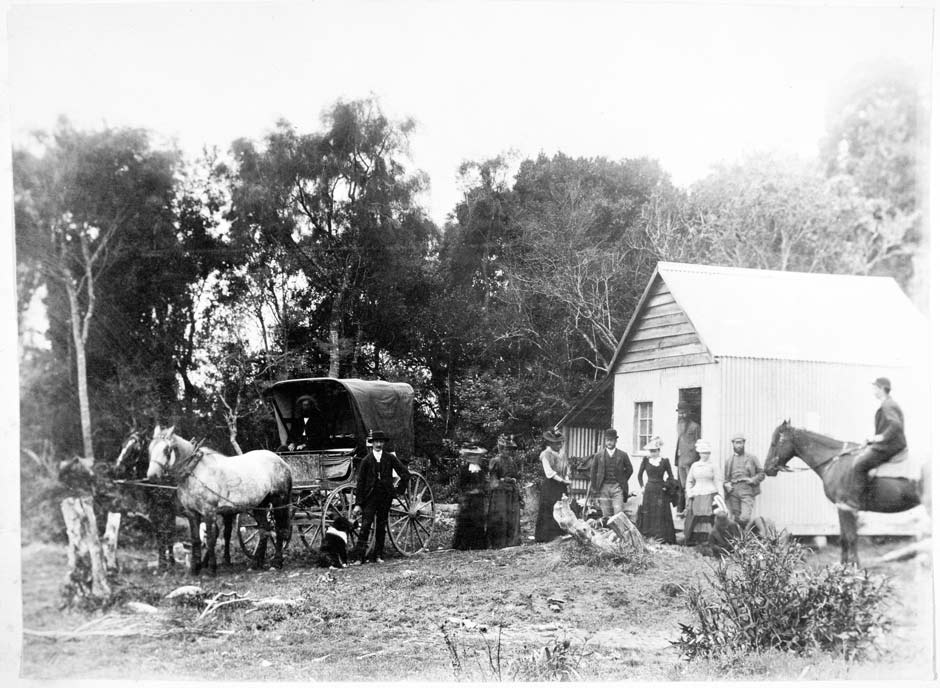
Women vote for the first time at a polling station in the tiny South Otago settlement of Tahakopa on 28 November 1893. Despite ominous warnings by diehard suffrage opponents that delicate female voters would be harassed and jostled, the conduct of the election was peaceful and orderly throughout the country.

Of the around 120, 000 NZ women at the time about 102,000 turned out to vote for the first time in the election following the Sept 19th law pass.

So – this Sept 19th (Wednesday), 125 years on – take a moment to think about the rights you have, how you got them and how you use them.